
Selecting the appropriate molded inductor (Molding Choke) for the circuit, not just by its appearance, but by focusing on its dynamic performance and physical limitations in the circuit.
Monolithic inductors are primarily used in power circuits (such as DC-DC converters) to perform energy storage, filtering, and freewheeling functions. To help you make the optimal choice,we will break down the selection process into the following five key steps:
1. Determine the physical dimensions and packaging (Step 1: Will it fit?)
This is the most basic screening criterion. Monolithic inductors are typically standard chip-like rectangular structures.
* Dimensional Constraints: Measure the size and height limits of the reserved pads on the PCB. Common dimensions include 3.0×3.0mm, 4.0×4.0mm, 5.0×5.0mm, etc., with heights ranging from 1.0mm to 5.0mm.
* Terminal Design: Confirm whether it is a standard “two-terminal” pin or a “four-terminal” pin design intended to reduce radiation.
* Note: Even if the length and width are the same, the height often determines the power tolerance of the inductor. Be sure not to choose the wrong one.
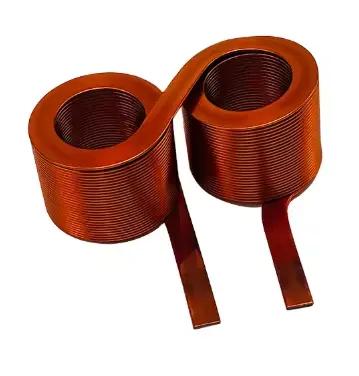
2. Calculate and match the inductance (L value)
The inductance determines the magnitude of current ripple. Choosing it too large or too small will affect power supply efficiency.
* Refer to the chip manual: The datasheets of most power management integrated circuits (ICs) provide recommended formulas for calculating inductance values.
The general formula can be approximated as L={(V_{in}-V_{out})XV_{out}/{V_{in}Xf_{sw}XI_{out} XRippleRatio}}
* where f_{sw} is the switching frequency, and RippleRatio is typically 20%~30%.
* Tolerance: Monolithic inductors typically have a tolerance of ±20% or ±30% (e.g., M or N grades), and a margin should be reserved during calculations.
3. Core current parameters: Both “currents” must be considered
This is the most error-prone part! The datasheet for integral molded inductors typically specifies two different rated currents, and both conditions must be met simultaneously:
* Saturation current (I_{sat}): Hard limit
* Definition: The current when the inductance drops to a certain ratio (typically 10% to 30% of the initial value).
*Selection method: I_{sat} must be greater than the peak current (I_{peak}) in the circuit.
*Peak current calculation: I_{peak} = I_{out} + ΔI_L/2 (i.e., the output current plus half of the ripple current).
*Consequences: If the I_sat is insufficient, the inductor will instantly saturate magnetically, causing a sharp drop in inductance and leading to a rapid rise in current, which may burn out the switching transistor.
Temperature rise current (I2 {rms}): heating index
*Definition: The root mean square current at which the surface temperature of an inductor increases by a specified value (usually 40 ° C).
*How to choose: I2 {rms} must be greater than the maximum output current (I2 {out}) in the circuit.
*Consequence: If I2 {rms} is not enough, the inductor will overheat, which not only reduces efficiency but may also damage the PCB solder joints.
4. Pay attention to DC resistance (DCR) and efficiency
DCR (Direct Current Resistance) is the resistance of the inductor coil itself.
*Impact: DCR can cause copper loss (P_ {loss}=I ^ 2 XR), which is directly converted into heat and reduces power efficiency.
*Balance: When size and cost allow, a smaller DCR is better.
5.Consider self resonant frequency
The electromagnetic induction phenomenon that occurs when the current flowing through the conductor itself changes. When a metal wire is used to make a coil and the current flowing through the coil changes, a significant electromagnetic induction phenomenon will occur. The coil’s self induced reverse electromotive force hinders the change of current and plays a role in stabilizing the current. Specifically, if an inductor is in a state where no current passes through, it will attempt to obstruct the current from flowing through it when the circuit is turned on; If an inductor is in a state where current is passing through, it will attempt to maintain a constant current when the circuit is disconnected.
Post time: Jan-21-2026